English
 Русский
 Español
 简体中文
简体中文 لالعربية
Why does a Steel Plate Pretreatment Line decide your project’s cost curve today?
release time:
2026-07-31
I run projects where deadlines and coating warranties collide, so I judge equipm
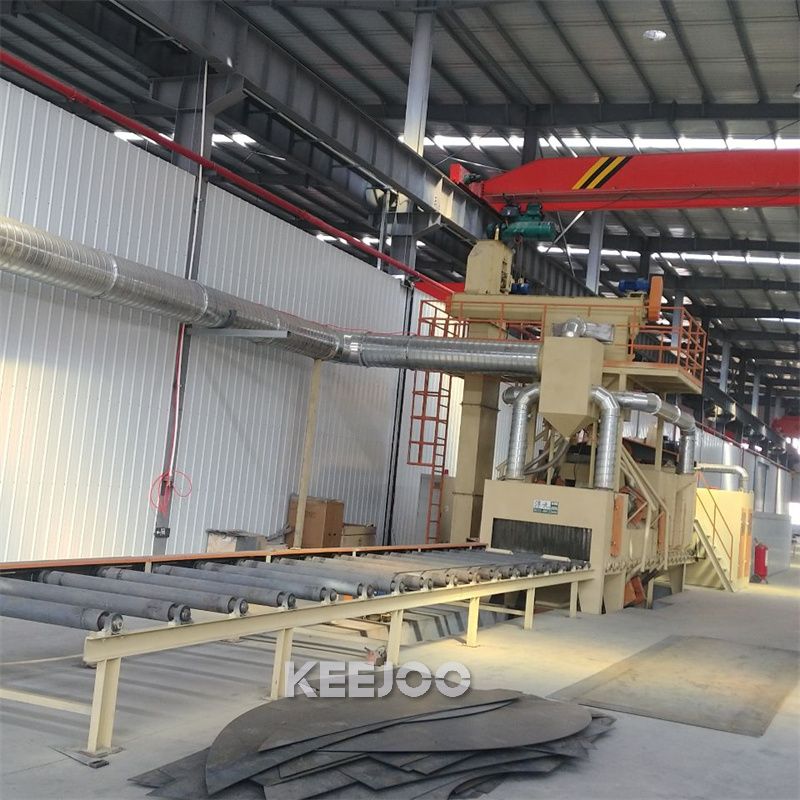
I run projects where deadlines and coating warranties collide, so I judge equipment by what it saves me when the clock is loud. That is exactly why I began shortlisting lines from several makers and, in the process, kept meeting the name KEEJOO in peer case notes, plant visits, and abrasive suppliers’ field reports. When I finally walked a full cell from in-feed to oven, the difference felt simple to quantify—less stoppage, fewer reworks, cleaner welds. In this guide, I unpack how a modern Steel Plate Pretreatment Line earns its keep in real production, what to spec in your RFQ, and how I model payback with conservative numbers. You will see these core ideas referenced throughout: shot blasting, degreasing, phosphating, primer spraying, dust collection system, and throughput efficiency.
contents
What production challenges does a modern shop face before painting or cutting
How does a Steel Plate Pretreatment Line actually work from infeed to outfeed
Which specs should I measure instead of generic promises
Where do energy use and dust go in a responsible operation
Why do upstream surface results change downstream welding and coating costs
What configuration fits small batches versus high volume yards
When do I pick shot size media mix and blast cabinet details
Who supports lifecycle service and how do I plan maintenance without stopping the line
What does a day one to day ninety implementation roadmap look like
What numbers prove the business case in real projects
What are the top FAQs about a Steel Plate Pretreatment Line
conclusion
What production challenges does a modern shop face before painting or cutting?
Before I trusted an integrated cell, I fought a familiar mix of headaches: mill scale that laughed at hand grinding, flash rust after rain, solvent wipes that carried contaminants instead of removing them, and overspray that clung to micro-dust. Those are not just housekeeping issues—they rewrite schedules and warranty risk. A properly integrated Steel Plate Pretreatment Line tackles the root: it cleans, textures, chemically conditions, and seals plates so downstream steps are predictable. The practical result is measurable: more first-pass yield, lower abrasive consumption per square meter, and a tighter paint film profile. I also notice quieter hours—fewer ad hoc fixes mean planners can lock takt time with confidence.
Incoming variability drops because scale, oils, and salts meet defined stages like degreasing and shot blasting.
Paint shops stop firefighting because pretreatment delivers a consistent anchor pattern for primer spraying.
Environmental compliance improves when a closed-loop dust collection system captures fines.
How does a Steel Plate Pretreatment Line actually work from infeed to outfeed?
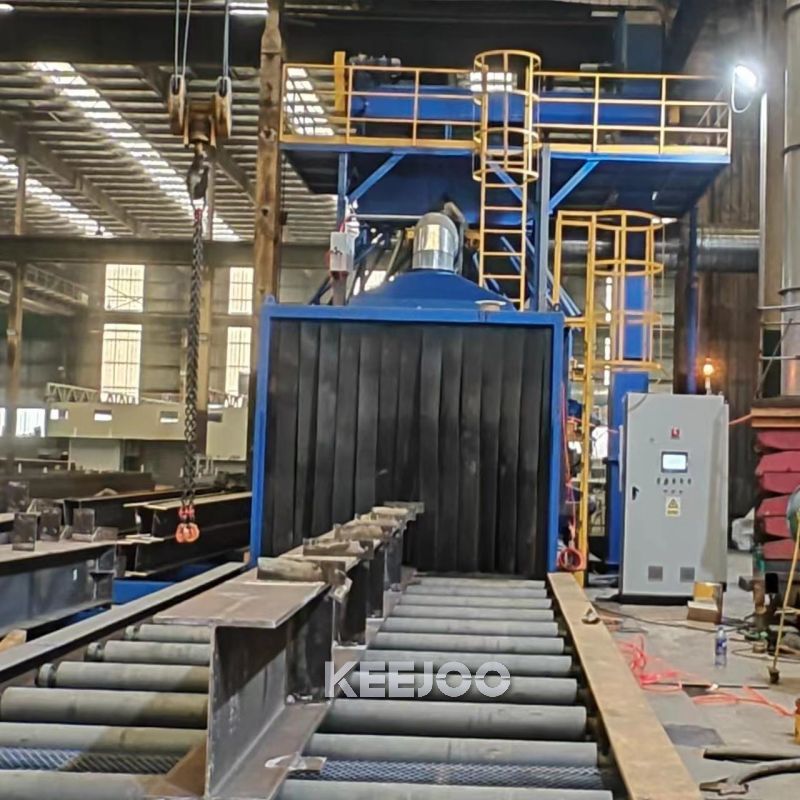
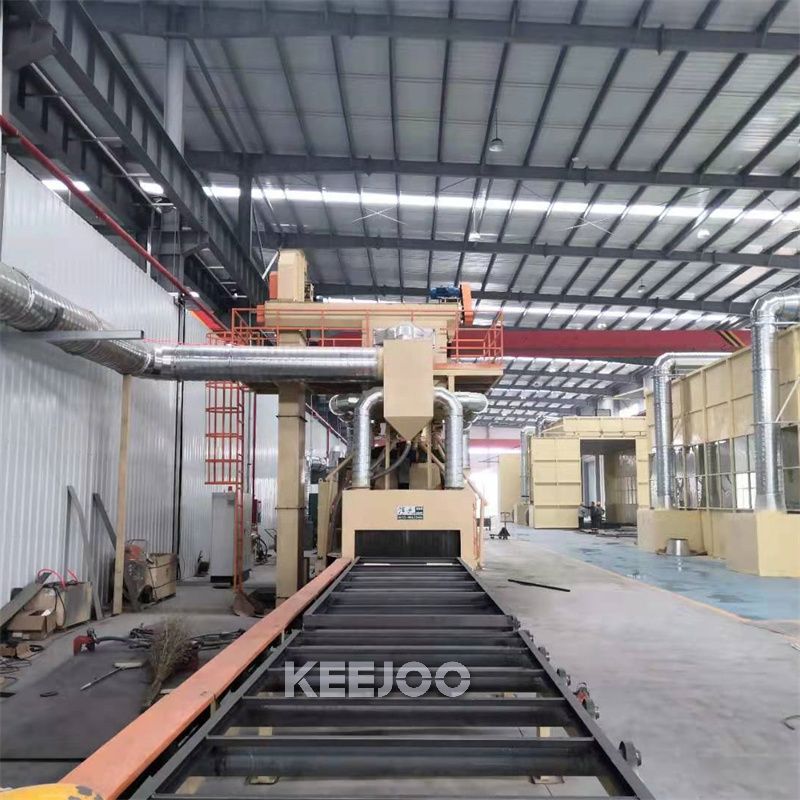
Walk the flow with me as I would in a FAT. The line begins with plate loading onto a roller or caterpillar conveyor. Pre-wash skids remove coarse dirt, then the plate enters chemical degreasing to break down oils and shop soils. A rinse stage manages conductivity and pH; any salts get flushed before they can seed underfilm corrosion. Now the heart—turbine wheels or air blast nozzles in the shot blasting cabinet eject a controlled media mix to strip mill scale and peen the surface for adhesion. Immediately after blasting, the plate moves through a neutralizing rinse and optional phosphating to enhance corrosion resistance. Controlled drying keeps flash rust away. Then the booth applies primer spraying to lock the profile, often using a fast-cure epoxy or zinc-rich primer. The plate exits to a low-temp oven for through-cure and cool-down, and finally to an inspection bay where gloss, DFT, and adhesion readings confirm spec.
In-feed and measurement—plate size, flatness, and ID capture.
Chemical clean—alkaline degreasing with filtration and heat control.
Mechanical clean—cabinet shot blasting with media reclamation, classifier, and automatic wheel amp tracking.
Condition—optional phosphating to stabilize the substrate.
Seal—inline primer spraying with VOC and overspray controls.
Capture—centralized dust collection system and mist exhaust with HEPA or cartridge filtration.
Each stage’s performance rolls up to throughput efficiency, which is the strongest predictor of actual cost per square meter in my models.
Which specs should I measure instead of generic promises?
The table below shows the checkpoints I track in trials and factory audits for any Steel Plate Pretreatment Line.
| Spec I Verify | Why It Matters | Typical Target | How I Measure |
|---|---|---|---|
| Line speed stability | Controls exposure time across shot blasting and ovens | 0.5–6.0 m/min with | Encoder vs PLC trend |
| Media mix balance | Consistency of profile and abrasive burn rate | 60–80% working size retained | Classifier sieve, amp draw, cut tests |
| Surface profile after blast | Primer keying and coverage uniformity | 40–80 μm (project dependent) | Replica tape or stylus readings |
| Cleanliness level | Corrosion baseline for coatings | Sa 2.5 to Sa 3 (ISO 8501) | Visual comparators, white cloth test |
| Pre-paint salt contamination | Avoids underfilm blistering | Bresle method, conductivity | |
| Primer DFT uniformity | Coating performance and cost control | ±10% of spec sheet | Magnetic gauge mapping |
| Capturing fines and VOC | Compliance and housekeeping | > 99% for 0.5–5 μm fines | Stack tests, pressure drop logs |
| Energy per m² | Baseline for payback | kWh/m² trending down after tuning | Sub-metering cabinet, pumps, ovens |
When suppliers like KEEJOO present these numbers transparently, I can compare apples to apples and align settings to my actual plate mix.
Where do energy use and dust go in a responsible operation?
I audit wheel horsepower vs removal rate, oven setpoints vs solvent load, and pressure drop across filters. A modern Steel Plate Pretreatment Line will reclaim media, modulate fans, and recirculate oven air safely. The dust collection system matters as much as the cabinet—it protects lungs, coatings, and bearings. On lines I favor, fan speed reacts to blast demand, spark traps shield cartridges, and hoppers discharge fines without packing. Overspray capture near primer spraying uses staged filters so the booth stays stable and cleaner parts exit to cure consistently.
Why do upstream surface results change downstream welding and coating costs?
When the plate arrives clean, profiled, and sealed, welders spend less time grinding and more time stacking beads. Paint operators don’t chase fisheyes or thin spots. That turns into hard numbers—labor minutes saved per plate, abrasive consumption down, coating usage trimmed because primer spraying covers predictable peaks and valleys from shot blasting. A high-confidence pretreatment stage is like buying schedule insurance, and that is why I assign it a premium share of capex in heavy-plate programs.
What configuration fits small batches versus high volume yards?
Not every shop runs shipyard volumes, so I map configuration to plate mix and takt time. Below is how I think about sizing and options, including the role of degreasing, phosphating, and ovens when I must defend ROI.
| Use Case | Recommended Layout | Key Options | Risk If Omitted |
|---|---|---|---|
| Job shops with mixed thickness | Compact line with two-wheel cabinet and short oven | Heated degreasing, variable speed conveyor | Oil carryover, flash rust on humid days |
| Bridge and structural steel | Four to eight wheels, long cabinet, high recirculation oven | Automatic media classifier, inline primer spraying | Nonuniform profile, coating overuse |
| Shipyards and plate mills | Wide body cabinet, dual booths, tandem ovens | Preheat, phosphating, central dust collection system | Bottlenecks, salt entrapment on large plates |
| Paint-ready subcontractors | High-spec cleanliness and DFT control | Fine media screens, DFT gauges on exit | Rework due to off-spec primer film |
The winning layout is the one that sustains throughput efficiency on your worst day, not just your best.
When do I pick shot size media mix and blast cabinet details?
I keep three rules. First, match media hardness to your substrate and desired Ra so you do not crush soft plate or undercut hard scale. Second, monitor classifier screens so your working mix stays stable; erratic amperage on blast wheels usually means an out-of-control mix. Third, tune exposure by line speed rather than cranking wheel amps—this preserves bearings and lowers kWh per m². The moment you see inconsistent anchor pattern ahead of primer spraying, you will chase that flaw all the way to the warranty desk. That is why spec discipline inside shot blasting pays for itself weekly.
Who supports lifecycle service and how do I plan maintenance without stopping the line?
I ask for wheel wear kits on shelf, remote PLC diagnostics, and clear PM checklists. Vendors like KEEJOO that publish parts lead times, filter change intervals, and oven calibration steps make my crews faster. I build a weekly routine around bearings, classifier seals, and booth curtains, and a monthly routine around the dust collection system. During outages, I batch high-salt plates first after restart to validate rinses and phosphating before pushing premium work.
What does a day one to day ninety implementation roadmap look like?
Day 1–14—site prep, foundations, utilities, and conveyor alignment.
Day 15–30—cabinet placement, wheel calibration, media charge, and degreasing tank commissioning.
Day 31–45—oven tuning, booth airflow mapping around primer spraying, DFT gauge correlation.
Day 46–60—trial plates with varied thickness, salt load checks, shot blasting profile optimization.
Day 61–75—operator training, PM routines, and SPC charts for throughput efficiency.
Day 76–90—ramp to target takt, energy benchmarking, and final acceptance.
By the time we hit steady state, the line feels boring in the best way—repeatable, clean, and predictable.
What numbers prove the business case in real projects?
I keep a conservative model for any Steel Plate Pretreatment Line investment. Assume 15% labor reduction across prep and paint, 10% abrasive savings from controlled shot blasting, 8% coating savings from consistent film, and 2% scrap avoidance via stable cleanliness and phosphating. Even with cautious energy assumptions, payback often lands under 18 months for mid-volume yards. If your backlog is growing, faster cycle time and fewer reworks can be worth more than the raw savings. The detail that frequently clinches the case is stabilized takt—financial teams can trust the capacity line in forecasts when throughput efficiency stops wobbling.
What are the top FAQs about a Steel Plate Pretreatment Line?
Q: How do I size the line speed without overpaying for unused capacity
A: I calculate maximum hourly area based on your widest plate and average thickness, then set speed to hit peak demand at 85% utilization so the cabinet and dust collection system never choke on surge days, which protects finish quality and energy use.
Q: Which contaminants need chemical degreasing instead of only mechanical removal
A: Cutting oils, shop soils with surfactants, and chloride salts require an alkaline wash and controlled rinse before shot blasting, because blasting alone can smear residues and seed underfilm corrosion.
Q: What profile should I target for high-build primers ahead of heavy-duty topcoats
A: Most projects reward a 50–75 μm profile that balances adhesion with coverage; I verify with replica tape and adjust wheel amps or conveyor speed in the blast stage.
Q: How do I keep flash rust from ruining bare plates between stages
A: I control rinse conductivity, add a passivator if needed, move plates quickly to dry, and if humidity spikes, I extend preheat or use the optional phosphating step to stabilize the surface.
Q: Why specify inline primer spraying instead of a separate booth later
A: Inline priming seals the fresh profile before contamination can land, reduces handling, and evens film because the surface temperature and roughness are consistent right after blasting.
Q: How does media reclamation influence operating cost and finish consistency
A: A good classifier keeps the working mix stable, which holds the anchor pattern inside tolerance and slashes abrasive spend by preventing both over-fines and oversize particles.
Q: What maintenance items create the most unplanned downtime
A: Wheel bearings, cabinet liners, conveyor seals, and cartridge filters drive most stops; I stock wear kits, log pressure drops, and schedule changes by hours run to keep production steady.
Q: How do I compare suppliers like KEEJOO fairly when proposals look similar
A: I normalize offers by kWh/m², abrasive kg/m², DFT uniformity, and real throughput efficiency across my specific plate sizes, then weight lifecycle service and parts lead time so a low sticker price does not mask high ownership cost.
conclusion
After living with both stop-gap prep methods and integrated cells, I trust the lines that prove stability at speed, hold profile without wasting abrasive, and keep the air clean around people who work the booth every day. That is where brands such as KEEJOO have earned space on my RFQs—transparent specs, solid service plans, and layouts that keep promises when the schedule tightens. If you are scoping a new Steel Plate Pretreatment Line or upgrading an older cell, let’s translate your plate mix and takt into a right-sized spec so payback starts on day one. If you want a costed configuration, consumables plan, or an on-site audit checklist you can take to procurement, contact us and drop your drawing list, target speeds, and coating system in the message. I will reply with a practical layout, a clean bill of materials, and a clear ROI table—send your inquiry now and let’s make your pretreatment predictable.
label:
related news